How to Choose Disposable Take-Out Containers: A B2B Buyer’s Framework
A practical framework for foodservice buyers selecting disposable take-out containers—from matching the menu to checking dimensions, materials, lids, and quote requirements.
2026-07-16 - 6 min read
Start with the food and service occasion
Choosing a disposable take-out container is not simply a matter of finding a box or bowl that looks right. For foodservice buyers, the better starting point is the menu, followed by the way the order will be packed, carried, and presented. A clear selection process also makes RFQs easier to compare across formats and suppliers.
TakeawayPack’s current product data includes cups, bowls, trays, boxes, lids, bags, cutlery, napkins/wipes, straws, and related formats. The practical framework below focuses on turning that range into a short, reviewable product list for your operation.
Before selecting a format, write a short brief for each menu item or service line. Include what is being packed; whether it is served hot, cold, or fresh; the portion size and usable footprint; whether a separate component needs its own space; and whether the order will be carried away, delivered, displayed, or served at an event.
This keeps the decision anchored in the application rather than a generic product name. It also helps your team decide whether the priority is a compact footprint, an open serving format, a lidded format, a divided tray, or a box with product visibility.
Choose the format before comparing individual products
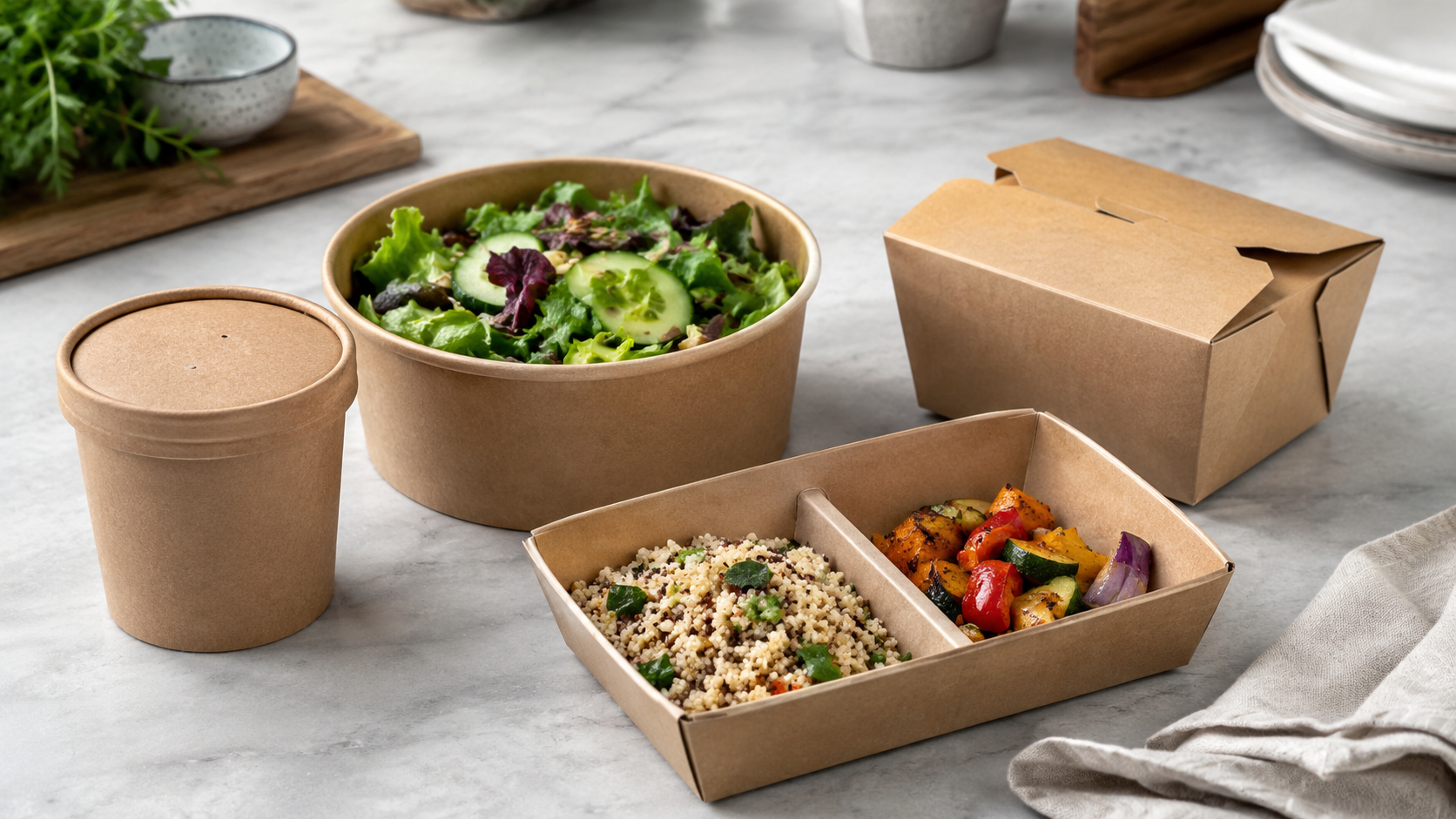
Cups and lids suit beverages, soups, and small portions. The current range includes paper cups, soup cups, plastic cold-drink cups, and separate lid products. For example, the Natural Kraft Soup Cup 350ml is listed as a paper cup for hot soups, stews, noodles, and other takeaway foods; its listed specification is 96mm top diameter, 77mm bottom diameter, and 60mm height. The data also includes a 96mm cardboard soup-cup lid.
For beverages, the range includes a Paper Cup 8oz for hot and cold drinks and a Plastic Cup 250ml for cold drinks. These are different applications, so buyers should evaluate them as separate menu solutions rather than treat all cups as interchangeable. Buyer check: record the cup or container rim dimension and confirm the matching lid by the supplier’s item-level specification or sample. A lid diameter alone is not a substitute for a confirmed compatibility check.
Bowls are useful when the meal needs a broader opening or a defined eating vessel. The verified range includes a Kraft Paper Salad Bowl 750ml for salads, fruit, grain bowls, and other fresh takeaway foods. It is listed with a 150mm top diameter, 128mm bottom diameter, and 50mm height. The range also includes a Squared Kraft Paper Bowl 700ml and a Rectangled Kraft Paper Bowl 750ml for salads, rice, noodles, and takeaway meals. Instead of choosing by capacity alone, compare the stated top, bottom, and height dimensions against the actual portion and any side items.
Boxes can be a better match when the menu calls for a folding or clamshell-style presentation. Verified examples include a Natural Kraft Hamburger Box 105mm for hamburgers, sandwiches, and takeaway fast food; a Noodle Box 480ml for noodles, pasta, rice, curry, fries, and other meals; and a Kraft Paper Salad Box-PLA Window 950ml for salads and takeaway food. A buyer comparing them should first decide whether the food needs a clamshell, a taller meal box, or a windowed box for visual presentation.
For snacks, handheld foods, or meals with separated portions, an open tray may be the appropriate starting point. The product data includes a 2-Compartment Paper Tray 94mm for separated food portions, as well as a Natural Kraft Cardboard Tray 122mm for snacks, fried foods, bakery items, and takeaway meals. Use the number of portions and the required separation as an early filter. If the food must remain fully enclosed during transport, move the comparison back to a lidded cup, bowl, or box format.
Compare material and construction only at item level
Material should be checked against the specific item rather than inferred from the category name. In the verified product data, the examples above are primarily listed as paper, while the range also contains plastic cups, PLA lids, kraft paper products, laminated paper products, PP products, and other material entries.
For every shortlisted item, ask for the product’s current material description, dimensions, and intended application. Do not transfer a claim from one item to another solely because both belong to the same category. If destination-market documentation, food-contact confirmation, temperature-use confirmation, or end-of-life claims matter to your purchase, request the applicable item-specific evidence before approval.
Make lid compatibility a separate decision
Containers and lids are linked operationally, but they should be quoted and checked as a set. The current range has a dedicated Lids category, including paper, plastic, and PLA lid entries. For example, the 96mm cardboard soup-cup lid is described for soup bowls, while the 90mm PLA lid is described for ice-cream cups and cold-dessert takeaway use.
For each proposed pairing, document the container SKU and its rim or top dimension; the lid SKU and its stated diameter or fit description; the food application and whether the final use is hot, cold, or fresh; and the result of a physical fit and transport test.
This simple pairing sheet reduces the risk of making a packaging decision from photos or category labels alone.
Turn the shortlist into a quote-ready brief
Once you have the right format, the RFQ should make comparison straightforward. TakeawayPack’s imported product records include fields such as product name, SKU, category, material, product specification, printing method, pieces per carton, and quantity/price tiers when available. Use those same fields in your request.
Include the product format, selected SKU or product name, material, required dimensions, compatible lid if applicable, quantity, destination, and printing requirement. The database lists Full Color, Silkscreen, and Unimprinted on the verified examples used above; confirm availability for the exact item and order before treating any printing method as final.
A concise selection checklist for procurement teams
Before approving a disposable take-out container, confirm that the product format matches the food and service occasion; the stated dimensions suit the actual portion and presentation; the material is verified for the exact SKU; any lid pair is confirmed through item specifications and a physical test; the required printing method is confirmed for the selected product; carton packing and quote terms are reviewed; and any compliance, temperature-use, or sustainability requirement is supported by item-specific documentation requested for the destination market.
Build your take-out packaging shortlist with TakeawayPack
If you are selecting packaging for a new menu, a seasonal launch, or a multi-item takeaway program, send TakeawayPack your menu format, preferred product type, dimensions, quantity, destination, and branding requirement. We can help organize a quote request around the relevant cups, bowls, trays, boxes, lids, and other available product categories.
Browse products or request a quotation with your menu and specification brief.