An Evidence-First Guide to Eco-Friendly Food Packaging for North American Foodservice Buyers
A practical framework for North American foodservice buyers comparing eco-oriented packaging materials, recovery routes, and item-level documentation.
2026-07-16 - 8 min read
TL;DR / Key Takeaways
TakeawayPack's catalog spans paper, PE-lined kraft, laminated paper, PLA, CPLA, PET, PP, and bamboo constructions across foodservice formats.
Eco-oriented foodservice packaging categories include paper-based formats, bioplastics such as PLA and CPLA, recycled-content plastics, bamboo-based products, and reusable formats; each category has a different construction and end-of-life pathway.
The FTC Green Guides define a substantial majority for an unqualified recyclable claim as at least 60 percent of consumers or communities where an item is sold having access to recycling facilities that accept the item.
BPI-certified compostable products are evaluated against ASTM D6400 or ASTM D6868 standards for composting in managed facilities, according to the Biodegradable Products Institute.
An eco-friendly packaging RFQ should identify the exact configuration, complete construction, food application, compatible components, destination market, target claim, and required evidence.
Eco-Friendly Packaging Decisions Affect Operations, Claims, and Market Access
Foodservice packaging affects food quality, customer handling, local recovery options, and the environmental claims a business can responsibly make. A material name alone does not describe how a complete package performs in a delivery workflow or how it will be handled after use.
For North American procurement teams, the practical stakes are immediate: a package must arrive intact, fit the menu, support the intended customer experience, and align marketing language with the applicable market. The U.S. Environmental Protection Agency explains that local recycling programs differ by community, making market-level planning part of a packaging decision.
Use this five-point review to turn a sustainability objective into a buying brief:
1. Define the food and service conditions. 2. List every material and component in the package system. 3. Identify the relevant recovery route in the destination market. 4. Request documentation that matches the proposed claim. 5. Pilot the exact configuration with the intended food and handling conditions.
Menu Conditions Determine the Right Foodservice Package Configuration
Temperature, moisture, grease, portion size, lid fit, and delivery dwell time determine the packaging configuration a foodservice buyer should evaluate first. A menu-specific brief gives procurement teams a concrete basis for comparing formats before they compare environmental claims.
Start with the food itself. Record serving temperature, moisture and grease exposure, fill level, opening size, expected dwell time, delivery or carryout handling, presentation needs, and whether the order requires a lid.
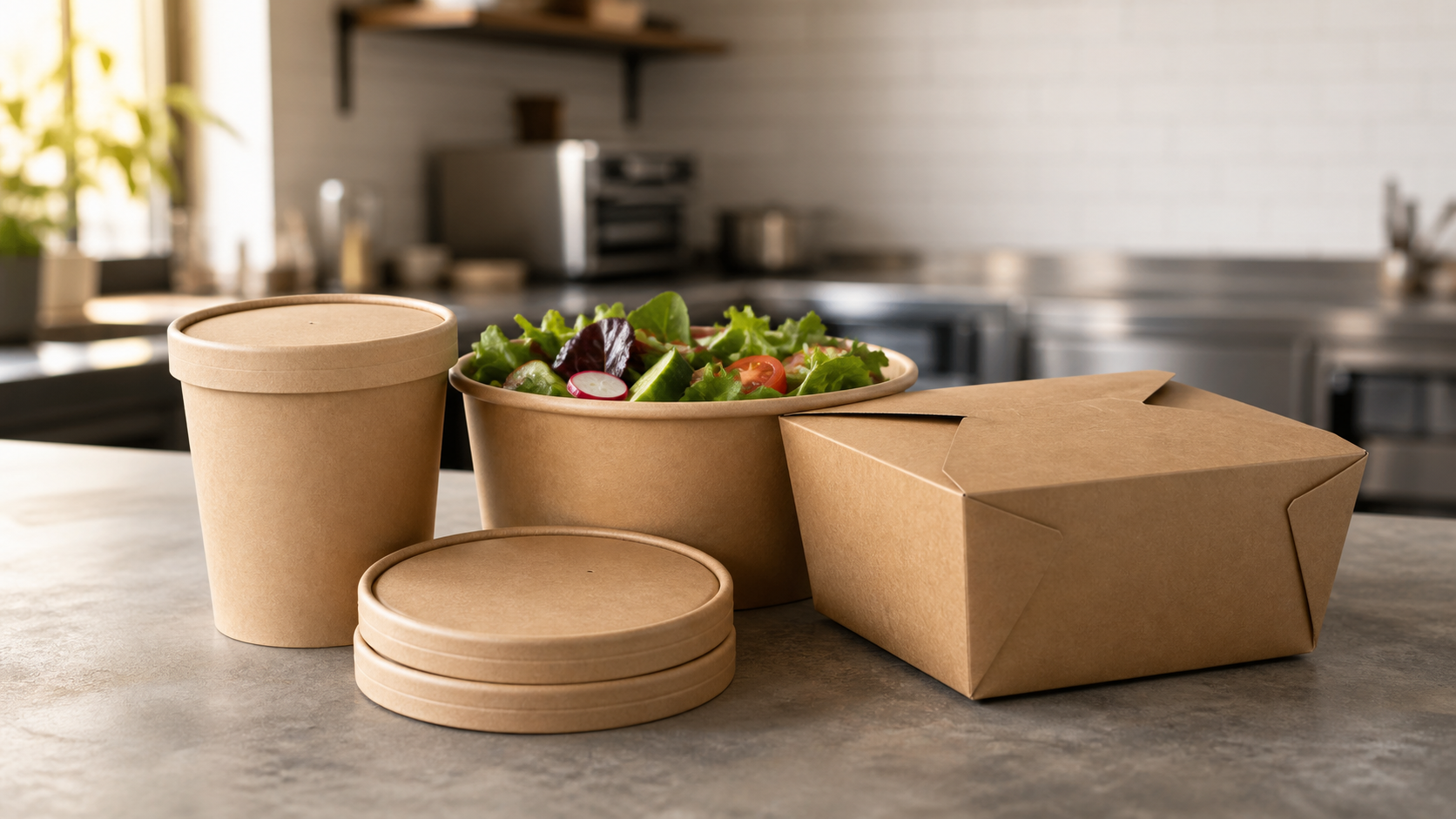
Catalog dimensions and stated uses help translate that brief into a shortlist. A natural kraft soup cup and lid may fit a hot, liquid menu item, while a wide paper bowl may fit a fresh salad or grain bowl; select the exact dimensions and compatible components for the intended service.
Lid fit is a configuration decision, not an accessory decision. Pair the container, lid, food, and handling conditions in the same evaluation before approving a format.
Full Package Construction Determines Which Environmental Claim Fits
Paper, PE-lined kraft, laminated paper, PLA, CPLA, PET, PP, and bamboo are distinct packaging constructions, and each construction requires claim-specific evidence and market-specific use. A paper-facing package with a liner, lid, label, or adhesive is a multi-component system rather than a single material.
TakeawayPack's catalog spans paper, PE-lined kraft, laminated paper, PLA, CPLA, PET, PP, and bamboo constructions across foodservice formats. These labels give buyers a practical way to create a format-specific shortlist for cups, bowls, boxes, trays, lids, and accessories.
For a recyclable claim, the FTC Green Guides state that an unqualified claim is appropriate only when a substantial majority of consumers or communities where the item is sold have access to recycling facilities that accept the item; the Guides define substantial majority as at least 60 percent. FTC Green Guides: Recyclable Claims
For a compostable claim, the FTC Green Guides distinguish between home composting and municipal or institutional composting, and direct marketers to qualify claims when appropriate. FTC Green Guides: Compostable Claims
List the container, coating or liner, lid, label, adhesive, cutlery, and bag before selecting claim language. That complete-construction record makes it possible to request evidence that matches the product actually being purchased.
Local Collection and Processing Determine Whether a Claim Works in a Service Market
A recyclable or compostable packaging claim becomes operationally useful only when the exact package configuration has a collection and processing route in the service market. Local programs, haulers, and processors define the route that connects a customer-facing claim to real-world handling.
Begin with the exact SKU and every component in the package system. Then identify the recycling or managed-composting program serving the location where customers will dispose of the item, and ask the relevant program, hauler, or processor about acceptance of that configuration.
For a BPI compostability claim, request SKU-level certification from TakeawayPack for the exact product and destination market. BPI states that its certified products meet ASTM D6400 or ASTM D6868 testing requirements for biodegradation in a managed compost facility.
Multi-location operators should maintain a market-by-market claim record. The same container may be used across locations while customer-facing disposal instructions reflect each market's available route.
Claim-Specific Documentation and a Controlled Pilot Belong in Every RFQ
An eco-friendly packaging RFQ is strongest when it specifies the intended claim, the evidence requested, and the pilot conditions for the exact package configuration. This approach allows procurement, operations, and sustainability teams to review the same requirements before a large order is released.
At minimum, include the product name, configuration-specific SKU, full construction, dimensions, intended food and service conditions, compatible lid or accessory, destination market, target claim, printing requirements, carton requirements, and pilot criteria.
Match each evidence request to the claim: FSC-related sourcing should be supported for the selected board grade and claim scope; recycled-content products should identify the exact configuration and shipment scope; and food-contact, compostability, recyclability, PFAS, and performance claims should be supported for the selected configuration and destination market. The Forest Stewardship Council explains that an FSC label on a finished product reflects chain-of-custody requirements through the supply chain.
Follow documentation with a controlled pilot. Test physical samples with the actual food, intended fill level, expected dwell time, closure method, delivery or handoff sequence, and realistic transport conditions.
Eco-Friendly Food Packaging Evidence Matrix
Every foodservice packaging construction can be compared through the same five decision fields: menu conditions, complete configuration, claim evidence, local route, and pilot outcome. The matrix below applies those fields to common foodservice package constructions without treating any construction as a generic environmental ranking.
Assign a named go/no-go owner from procurement, operations, sustainability or compliance, plus the local market owner. That ownership keeps product selection, claim language, and service-market instructions aligned.
| Construction | Menu / service questions | Record before approval | Claim / proof to request | Local route and pilot |
|---|---|---|---|---|
| Paper | Food type, temperature, moisture, portion, hold time, lid need | Product, dimensions, coating or liner, lid and accessories | Item-specific evidence for each intended claim | Confirm local route; pilot actual food and handling |
| PE-lined kraft | Food and delivery conditions plus composite construction | Paper layer, PE liner, closures, labels, and components | Claim-specific proof for the complete configuration | Confirm local route; pilot actual food and handling |
| Laminated paper | Food and delivery conditions; moisture or grease exposure | Lamination, dimensions, lid, accessories, stated use | Item-specific evidence for each intended claim | Confirm local route; pilot actual food and handling |
| PLA / CPLA | Application, temperature, lid pairing, market | Configuration, dimensions, components, stated use | SKU-level certification or documentation for a compostability claim | Confirm managed-facility route; pilot actual food and handling |
| PET / PP / bamboo | Menu, temperature, display, component pairing | Exact product, dimensions, label, lid, accessories | Item-specific evidence for the intended claim | Confirm local route; pilot actual food and handling |
Sample RFQ Walkthrough: A Hot Grain-Bowl Delivery Program
An evidence-ready RFQ for a hot grain-bowl delivery program specifies the bowl-and-lid configuration, complete construction, service conditions, destination market, target claim, and requested documentation. The scenario below is illustrative, not a customer case or a reported TakeawayPack project.
Imagine a regional fast-casual operator preparing a hot grain-bowl delivery program for multiple North American markets. The buying brief identifies hot food, sauce exposure, a defined portion, a lidded bowl, delivery dwell time, printed branding, and market-specific disposal instructions.
The RFQ requests a shortlist of bowl-and-lid configurations with complete material descriptions, dimensions, compatible components, carton details, and documentation for the environmental claim the operator intends to use. The operator then selects samples, runs a filled-bowl delivery pilot, confirms the local recovery route for each launch market, and approves customer-facing wording that reflects the selected configuration and market.
The result is a quote comparison that connects product fit, documentation, local handling, and rollout ownership. This format makes the team’s assumptions visible before it commits to an order.
Frequently Asked Questions About Eco-Friendly Food Packaging
Foodservice packaging claims apply to complete product configurations and destination-market recovery systems, not to a material name alone. The following answers give procurement teams a direct starting point for common packaging questions.
What is the difference between recyclable, compostable, biodegradable, renewable, and reusable food packaging?
Recyclable, compostable, biodegradable, renewable, and reusable are different packaging claims with different evidence requirements. Recyclable claims relate to collection and processing; compostable claims relate to specified composting conditions; renewable claims describe material inputs; and reusable claims describe repeated-use systems.
How do I know whether a compostable takeout container is accepted in my city?
A compostable takeout container is suitable for a city program when the program or its contracted hauler or processor accepts the exact container-and-component configuration. Request SKU-level compostability documentation, identify the applicable local collection route, and align disposal instructions with the route serving the foodservice location.
Can paper or kraft packaging be called recyclable?
Paper or kraft packaging can carry a recyclable claim when the complete package configuration is accepted through the applicable recovery route and the claim follows the FTC Green Guides. Review liners, coatings, labels, lids, and food-contact conditions with the primary container before finalizing the claim.
Are PLA and CPLA products compostable?
PLA and CPLA products can carry a compostability claim when the exact product has the applicable certification and the destination market provides a managed-composting route for the complete package system. Request the certification for the exact item, including its associated components, before using compostability language.
What should I test before changing food packaging suppliers or materials?
Test the exact container-and-lid configuration with the actual food, fill level, expected dwell time, closure method, handling sequence, and delivery or handoff conditions. Record the configuration, route, observations, and decision owner so the approval reflects the real service environment.
What documentation should a sustainable packaging RFQ include?
A sustainable packaging RFQ should include the exact product configuration, complete construction, dimensions, intended use, compatible components, destination market, target claim, printing and carton needs, and pilot criteria. Add a claim-specific evidence request so suppliers can respond against the same standard.
Can TakeawayPack provide FSC, GRS, or food-contact documentation?
TakeawayPack can review requests for FSC, GRS, or food-contact documentation when the inquiry identifies the order, SKU, shipment, and destination-market scope. Include those details with the product configuration and intended claim so the documentation request is matched to the purchase.
A Market-Specific Package System Creates a Defensible Sustainability Decision
The most defensible eco-friendly packaging decision is an item- and market-specific package system that fits the food, operating conditions, recovery route, documentation, and pilot result. This evidence-first approach turns a broad sustainability objective into a configuration that procurement and operations teams can approve with confidence.
Send TakeawayPack your menu brief, service conditions, destination market, target claim, and documentation requirements to request an SKU-level configuration and evidence checklist. You can also browse TakeawayPack products, review certifications and materials, or request a quote.